Memorizing DBCC commands (or any command for that matter) can be difficult if you don’t use it often. Thank goodness for the folks at Microsoft for creating the DBCC HELP command. Below is a quick way to use DBCC HELP to figure out any command (with syntax) that might have slipped your mind. Continue reading “How to use DBCC HELP”
Use sys.dm_os_waiting_tasks to Find Blocking Transactions
If you want to do a quick and simple exercise to view blocking transactions on your SQL Server machine (code at bottom of blog).
I create a dummy table called “BlockingTable” and insert 10 rows of data. I then open a transaction and doing a simple update of the table. I leave the transaction open and open three new sessions. Continue reading “Use sys.dm_os_waiting_tasks to Find Blocking Transactions”
NEW Features in SQL Server 2016 – User Group Notes
I attended my second Northern Virginia (NOVA) SQL User Group session last night. The session was called, “SQL 2016 – Cool New Features” by Microsoft SQL PFE Harsh Deep (blog) Continue reading “NEW Features in SQL Server 2016 – User Group Notes”
INDEX REORGANIZE vs REBUILD in SQL Server
This blog post is meant to help distinguish the differences between REORGANIZE and REBUILD when it comes to index fragmentation. If you are serious about learning more of the internals of how indexing works in SQL Server, watch Kimberly Tripp’s (blog | twitter) video called, “Index Internals” here (open link and scroll down to “Index Internals”). Continue reading “INDEX REORGANIZE vs REBUILD in SQL Server”
How to Find SQL Server Edition Information
Most recently I had to figure out the edition (Enterprise, Standard, etc.) of SQL Server running on a specific production database server. The client wanted to know to what extent was the database server STIG’d. Continue reading “How to Find SQL Server Edition Information”
SQL Server DDL vs DML
For the longest time I’ve had a hard time remembering the difference between SQL Server DDL vs DML statements. I had a hard time remembering what statement fell under what category. Was INSERT, UPDATE, DELETE a DML command or DDL? What about CREATE / ALTER? It was all confusing to me. Continue reading “SQL Server DDL vs DML”
What’s Msg 208, Level 16, State 1, Line 1
It’s usually something simple that’s overlooked that ends up causing the biggest troubleshooting headache. Let me explain. I was creating a test database called “testDB” with a test table called “testTable” (yes I know, I put a lot of thought in the naming of these objects) and when I tried to insert data into this new testTable I got the following error:
Msg 208, Level 16, State 1, Line 1 Invalid object name ‘testTable’.
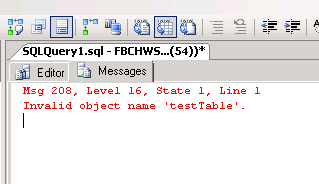 What the hec? How can it be an invalid object? I just created it! Continue reading “What’s Msg 208, Level 16, State 1, Line 1”
My First SQL Server User Group Session
I attended my very first SQL Server User Group meeting last night and it was awesome! I want to start by giving my friend Tim Radney a BIG thank you for telling me about the importance of attending these sessions!
THANKS brother!
I joined the Northern Virginia (NOVA) SQL User Group a few weeks ago and attended my very first session last night. The session was called, “Hands-On Lab- Migrating a SQL Server Database to a Microsoft Azure SQL Database” and it was an online lab. Continue reading “My First SQL Server User Group Session”
My Review of Immersion Event on Performance Tuning and Optimization 1
I was fortunate enough to attend IEPTO1 (Immersion Event on Performance Tuning and Optimization part 1) by Kimberly Tripp (twitter) and Paul Randal (twitter) of SQLSkills this past Spring. It was absolutely amazing! If you are a DBA, developer, or just an IT tech geek who loves to learn then you must attend this event. Find registration information here. Continue reading “My Review of Immersion Event on Performance Tuning and Optimization 1”
How to Stop & Delete a SQL Server Trace
There were a few times where I had to delete/close an existing SQL Server Trace and create a new one. It’s a 2-step process to completely remove a SQL Server Trace. First, you stop the trace. Second, you delete/close it.
sp_trace_setstatus takes 2 parameters, trace id and status. Continue reading “How to Stop & Delete a SQL Server Trace”
How to Refresh IntelliSense Cache in SSMS
I recently created a database called “testDB” and when I typed “USE testDB” in the SSMS Query window it gave me a little red squiggly underline (see below snapshot).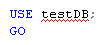 Why did this happen when I just created a new database? That’s because the local IntelliSense cache hasn’t updated yet. Continue reading “How to Refresh IntelliSense Cache in SSMS”
How to Find the Space Used in Your Data Files
I recently had to resize a data file on of my production SQL Server databases and needed to know an appropriate size to resize it to. So, I created this simple script that queries sys.database_files and brings back the File ID, File Location, File Name, Original Size, Space Used and Space Left.
[snippet id=”22″] Continue reading “How to Find the Space Used in Your Data Files”Gain More Real Estate in SQL Server Management Studio
The default layout in SSMS is too restrictive. I’m always having to scroll up and down and it gets pretty annoying. So I made a simple settings change that gives me more “real estate.” Continue reading “Gain More Real Estate in SQL Server Management Studio”
Msg 5041, Level 16, State 1, Line 1 – Resize Datafile
Recently, I wanted to resize the tempdb file size to 2 MB so I ran the below script:
ALTER DATABASE tempdb MODIFY FILE (name = tempdb, size = 2MB);
GO
and got the below error:
Msg 5041, Level 16, State 2, Line 1
MODIFY FILE failed. File ‘tempdb’ does not exist. (screenshot below)
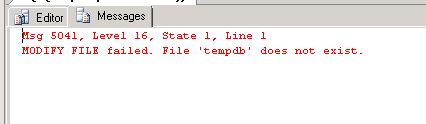 Continue reading “Msg 5041, Level 16, State 1, Line 1 – Resize Datafile”
How to Find Last Time SQL Server Restarted
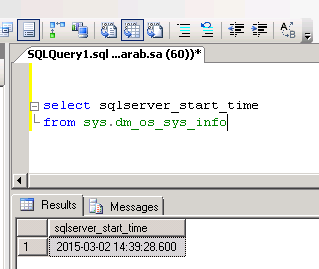
If you want to find the last time your SQL Server was restarted, the quickest way is to query the sys.dm_os_sys_info DMV for the ‘sqlserver_start_time’ column (See snapshot below)